Jan 17, 2026
 13
13
 lichi
lichi
Flank wear is the most common wear form and the core criterion for tool dullness per ISO 3685 (VB value). Its physical essence lies in the continuous friction between the flank face and the machined surface, which generates a wear land with zero clearance angle. This shifts the actual cutting edge position relative to the theoretical one, causing an undercut phenomenon – outer diameters become oversized, while inner diameters become undersized.
Quantitative relationship: When finish-turning 45# steel, every 0.1 mm increase in VB expands the workpiece diameter by approximately 0.008–0.012 mm.
Life threshold: For carbide tools, VB = 0.3 mm marks the tool life endpoint, requiring mandatory replacement.
Compounding effect: Flank wear intensifies cutting forces, induces deflection errors, and further amplifies the risk of dimensional out-of-tolerance.
Crater wear occurs on the rake face near the cutting edge, driven by chip friction and high cutting temperatures. When the crater depth KT > 0.2 mm, chip flow becomes erratic, promoting built-up edge (BUE) formation. Surface roughness Ra deteriorates sharply from 0.8 μm to over 2.5 μm. Non‑uniform crater wear also alters cutting force directions, causing workpiece deflection and resulting in out‑of‑tolerance cylindricity and flatness – especially critical in precision machining.
Notch (boundary) wear: Commonly seen when machining stainless steels and superalloys, with depths up to 0.5 mm or more. It directly damages the cutting edge profile, leading to significant shape errors in complex contour machining.
Nose wear: Changes the nose radius and the actual tool tip position, directly impacting the accuracy of tool radius compensation. It is the most sensitive factor affecting surface quality and dimensional precision.
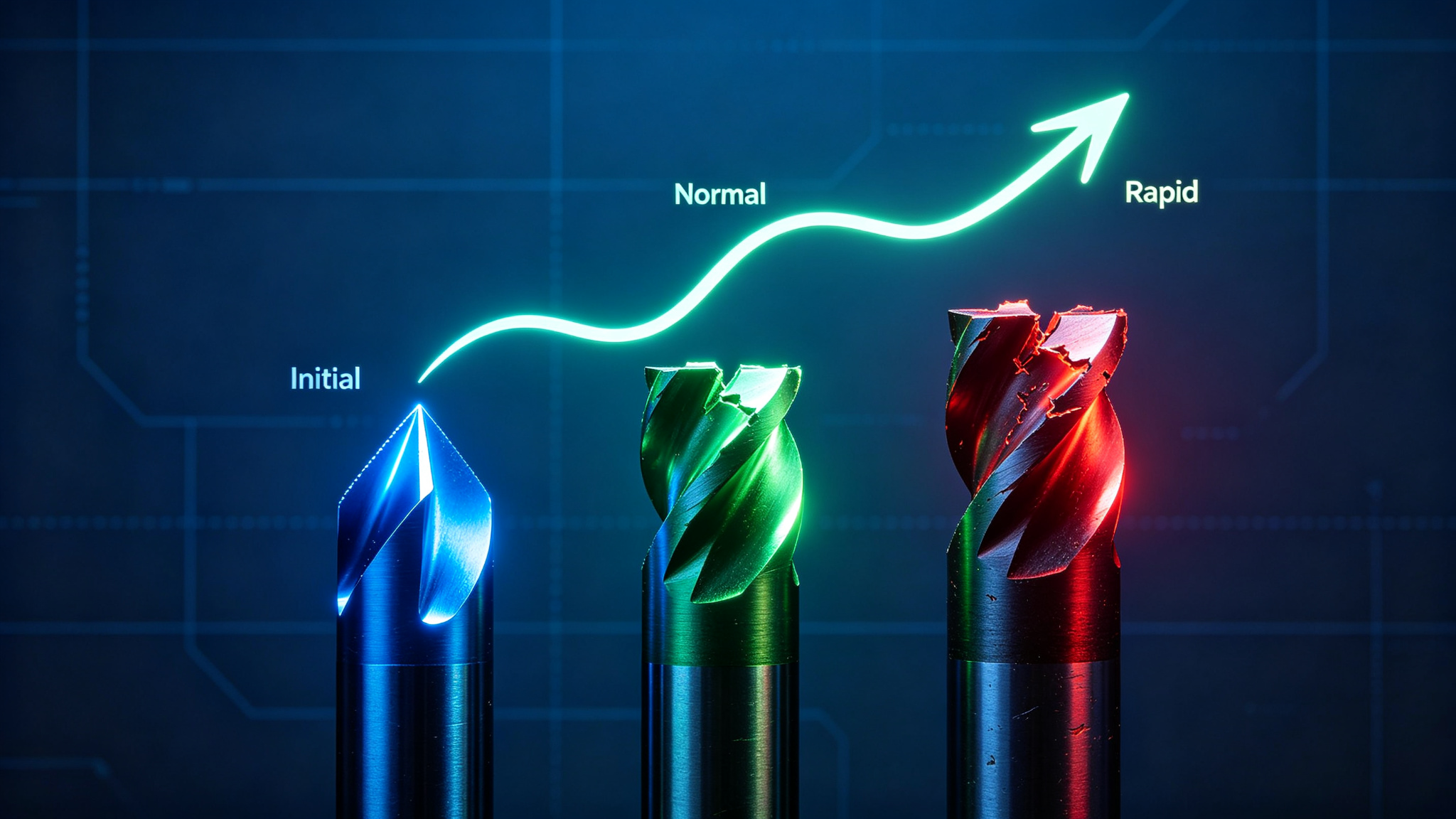
| Wear Stage | VB Range | Error Characteristics | Recommended Action |
|---|---|---|---|
| Initial wear | ≈0.05–0.1 mm | Rapid change, significant dimensional fluctuation | Trial cuts, process stabilization |
| Normal wear | Steady rise phase | Unidirectional drift, well‑controllable | Periodic measurement, apply tool compensation |
| Rapid/accelerated wear | Quick expansion | Sharp rise in cutting forces & vibration, rapid over‑tolerance | Immediate tool replacement to avoid scrap batches |
Increased cutting forces → Deflection errors: Wear enlarges the edge radius and alters friction coefficients, raising principal and radial forces. The resulting elastic deformation of the process system (tool‑workpiece‑machine) reduces actual depth of cut, causing undercut.
Cutting edge position shift: Flank wear pushes the edge backward, and nose wear displaces the tool tip, producing systematic unidirectional deviations (outer diameter grows / inner diameter shrinks).
Heat accumulation → Tool thermal elongation: Rising cutting temperatures cause tool thermal expansion, moving the tool tip. This forms a vicious cycle with wear, exacerbating thermal‑induced dimensional errors.
Increased vibration and runout: Worn edges trigger chatter, inducing random dimensional fluctuations that are difficult to correct with conventional compensation.
Mathematical Modeling of Wear‑Induced Errors (Supporting Quantitative Prediction)
Basic model: Pure wear diameter error Δd = 2·Δu (where Δu is the normal component of flank wear)
Comprehensive model: ΔD = f(VB, r_ε, α₀) (incorporating nose radius and tool clearance angle)
Extended predictive equation (based on Taylor’s tool life model):
ΔD = k₁·v_c^{n₁}·f^{n₂}·a_p^{n₃}·T^{m}
This allows quantitative evaluation of how cutting speed, feed rate, depth of cut, and cutting time affect dimensional drift – providing a basis for process optimization.
Sensitivity of Process Parameters to Wear‑Error Propagation
Cutting speed: A 20% increase halves tool life, accelerates VB growth, and speeds up dimensional drift.
Feed rate: Increased feed raises radial forces, exacerbating flank wear and deflection errors.
Depth of cut: Heavy roughing accelerates wear; uneven finishing allowances cause force fluctuations.
Three Compensation Strategies – From Manual to Intelligent
| Compensation Type | Implementation | Accuracy Capability |
|---|---|---|
| Manual wear compensation | Operator measures and inputs tool wear offset (e.g., outer diameter +0.1 mm → X‑axis input -0.1) | ±0.02~0.05 mm |
| Automatic compensation (macro) | FANUC/SIEMENS systems separate geometric and wear offsets; macros auto‑update wear registers | ±0.01~0.02 mm |
| In‑process measurement closed‑loop | Integrated touch probes perform post‑process auto‑measurement; deviation fed back to CNC for compensation code generation | Within ±0.01 mm, ideal for batch production |
Search‑focused keywords: CNC tool compensation methods, how to adjust CNC dimensional deviation, in‑process measurement closed‑loop control, tool offset setting
Mainstream Tool Wear Monitoring Methods
Indirect monitoring: Monitoring cutting force signals, spindle power/current, and vibration features to infer wear state.
Direct measurement: Touch probes, machine vision (image‑processing to extract wear regions), and optical non‑contact measurement (micron‑level accuracy).
Multi‑sensor fusion: Combining force + vibration + temperature + power signals for higher reliability and reduced false alarms.
AI‑Powered Intelligent Compensation Systems
Leveraging deep learning (e.g., CNN, LSTM) to fuse multi‑source signals, predicting wear levels and dimensional deviations in milliseconds after machining. The system automatically decides whether to apply compensation or replace the tool. Key advantages:
Reduces manual inspection frequency and lowers inspection costs
Extends tool utilisation and reduces changeover downtime
Enables predictive maintenance, preventing sudden tool failure and scrap
Complete Closed‑Loop Control Chain
Data acquisition (sensors / probes) → State recognition (signal processing + pattern recognition) → Error prediction (wear‑error models) → Compensation decision (amount & timing) → Automatic execution (update tool offset table, CNC real‑time application)
How much does tool wear affect dimensional accuracy?
→ Every 0.1 mm increase in flank wear VB adds 8–12 μm to diameter deviation – critical in finishing.
How can I reduce dimensional changes caused by tool wear?
→ Optimise cutting parameters (moderately lower cutting speed), improve cooling/lubrication, and apply online compensation.
Why does the machined size gradually increase on a CNC lathe?
→ Typically caused by flank wear leading to undercut; apply tool wear compensation or replace the insert.
What are practical methods for tool wear monitoring?
→ Touch probe direct measurement, vibration/power indirect monitoring, and machine vision online inspection.
How to tackle rapid tool wear when machining stainless steel?
→ Use wear‑resistant coated carbide grades, reduce feed rate, and enhance coolant application.
Tool wear affects CNC turning dimensional accuracy through multiple mechanisms, distinct stages, and quantifiable relationships. Key takeaways:
Flank wear (VB value) is the most critical quantitative indicator for dimensional deviation, showing a clear positive correlation with machined diameter.
The three‑stage wear evolution provides a scientific basis for establishing tool change intervals and compensation timing.
By combining wear‑error mathematical models with CNC compensation functions (manual → automatic → closed‑loop), dimensional errors can be stably controlled within ±0.01 mm.
AI + multi‑sensor fusion for intelligent monitoring and automatic compensation represent the future of smart manufacturing and adaptive machining, driving the implementation of total tool life‑cycle management and zero‑defect manufacturing.

No.1-2, Maning Village Committee Industrial Zone, Xingtan Town,Shunde District, Foshan City
+86 18923287232
lichicnc@gmail.com